 Joint letter to the Home Secretary
Guide to immigration changes
Social media action kit
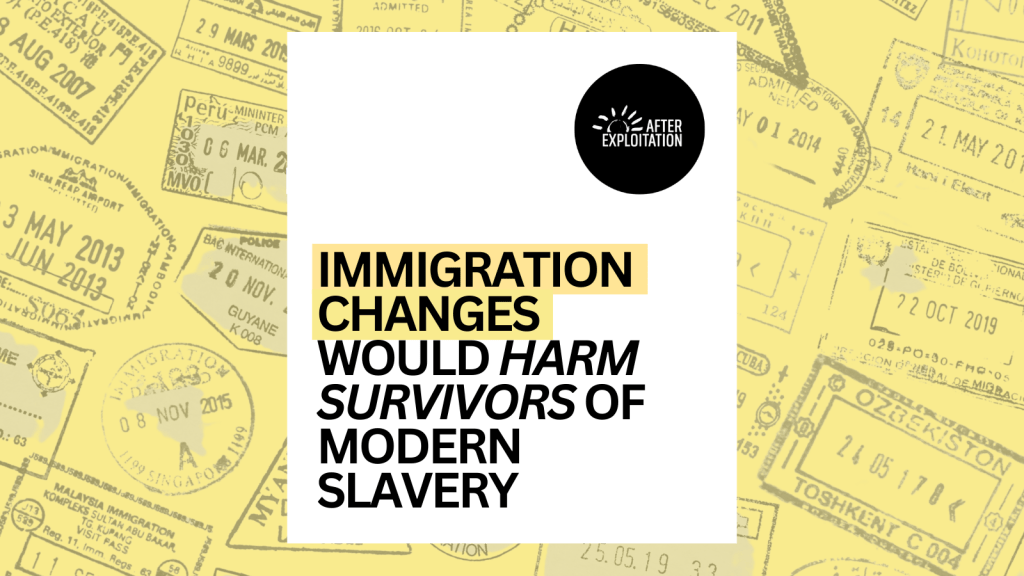
On 21st November 2025, the UK’s Home Secretary announced government plans to weaken protections for refugees, make it harder to seek asylum, and potentially make it more difficult to be recognised as a victim of modern slavery.
Whilst many survivors of modern slavery and human trafficking are UK nationals, many others are not.
Survivors sometimes need to claim asylum because they are persecuted or at risk, often due to factors related to their exploitation. Others are workers made vulnerable to exploitation due to immigration rules. This includes those forced to work in one sector, or tied to an employer, due to visa rules, and those put at risk of destitution, immigration detention, and removal or deportation if they report exploitation by an employer.
The new government announcement on immigration would make life much worse for survivors of modern slavery and human trafficking seeking asylum in the UK.
These changes would:
Potentially abandon survivors of modern slavery
We are still waiting to hear about the planned changes to modern slavery law, but remain concerned by the government’s claim that the system for recognising survivors must be made even stricter.
Survivors are already put under the microscope by a system which expects them to drum up more and more detailed evidence, earlier and earlier in their recovery with few chances to have a decision overturned.
Rob people of security
People who have been recognised as refugees will be expected to keep applying for a short-term status called ‘core protection’ for at least twenty years (once every 2.5 years) until they are given permanent status. Each time they apply to extend they will be under threat of refusal and being returned to their country of origin if the Home Office deems it to be ‘safe’ at the time of applying.
This state of limbo seriously undermines recovery and integration, leaving people seeking asylum with fewer rights while they wait. Research shows that temporary immigration status can increase people’s risk of exploitation.
Make people homeless
The government says it plans to weaken responsibility to provide shelter for people seeking asylum, including survivors of modern slavery. The plans would also make it easier for support to be withdrawn. Research shows exploiters often target those without housing, yet this policy pushes even greater numbers into homelessness.
Force people further into poverty
Financial support for people seeking asylum is already low, set at £49 a week or £9 a week for people in catered accommodation. Stripping back support even further puts more people at risk of poverty without tackling the very real barriers to working. For example, people seeking asylum are currently banned from working for the first year and, after this, only allowed to apply for roles on a list of permitted jobs which is very short. Around 111 roles, including vitals jobs such as teaching assistants and medical technicians, were removed from the list of professions asylum seekers are allowed to do in July 2025. There have never been more barriers preventing people seeking asylum from working.
Ramp up removals and deportations
The government wants to ‘increase removals and deportations’, but the number of people in danger due to conflict and persecution is growing, not falling. Worryingly, countries like Syria are being re-branded as ‘safe’ in order to speed up removals. Many countries deemed ‘safe’ already, such as Albania, pose a particular risk to survivors of trafficking if returned.
The government also wants to reinterpret important protections under the European Convention on Human Rights (ECHR) on the grounds of inhumane and degrading treatment (Article 3) and right to private and family life (Article 8), to allow for more deportations including those who have experienced modern slavery. This would significantly disrupt survivors’ recovery and obscure access to justice.
WE’RE CALLING ON THE GOVERNMENT TO…
- Commit to strengthening, not weakening, support for survivors of modern slavery. This means guaranteeing support (legal advice, counselling, subsistence and safe housing) for those recognised as potential victims, and reversing unrealistic evidence burdens ushered in via the Nationality and Borders Act (NABA) and Illegal Migration Act (IMA).
- Remove barriers to work and recovery, allowing people seeking asylum to work and apply for refugee status on day one. People on the move, including those seeking asylum and those who have come to the UK on work visas, should have a clear pathway to settlement.
- Make asylum decisions based on evidence and safety needs, not populist ideas of ‘deserving’ and ‘undeserving’ refugees.
- Prevent homelessness amongst people seeking asylum, including survivors of modern slavery, recognising the government’s responsibility for their housing needs without exception.
- Move away from deportation and immigration detention as a first resort, in recognition of the harm caused by these practices.
- Ensure the goal posts aren’t moved for people already in the UK and subject to immigration controls, ensuring any changes to law or guidance are not made retroactively or applied to people already awaiting an asylum decision
We stand with leading organisations, either supporting or led by survivors of modern slavery, in writing to the Home Secretary about these changes:
After Exploitation,
AIRE Centre,
Anti-Slavery International,
Anti-Trafficking and Labour Exploitation Unit (ATLEU),
Basis Yorkshire,
BAWSO,
Ella’s,
English Collective of Prostitutes (ECP),
Focus on Labour Exploitation (FLEX),
Freedom United,
Hibiscus Initiatives,
Hope at Home,
Immigration Law Practitioners’ Association (ILPA),
Kalayaan,
Medaille Trust,
No-One Above,
Refugee Action,
Rene Cassin,
Secrets Worth Sharing,
Social Workers Without Borders,
Sophie Hayes Foundation,
The Vavengers,
The Voice of Domestic Workers,
The UK BME Anti-Slavery Network (BASNET)
FURTHER READING:
Many more policies have been announced, and the detail of some plans are still being decided.
For a full breakdown of the changes, we recommend reading FreeMovement’s explainer on the changes, the landing page maintained by Greater Manchester Immigration Aid Unit (GMAIU) and the comprehensive table of policies (‘now’ vs potential ‘future’ laws) put together by Right to Remain.
We also recommend reading Women for Refugee Women’s overview of the changes’ impact of women seeking refuge and Hibiscus Initiative’s work highlighting the impact on Black and minoritised women.
![Opportunity: Campaign steering group [paid]](https://afterexploitation.com/wp-content/uploads/2026/02/are-you-a-campaigner-for-survivor-rights-freelance-role-1-e1770458275932.png?w=1024)




 After Exploitation