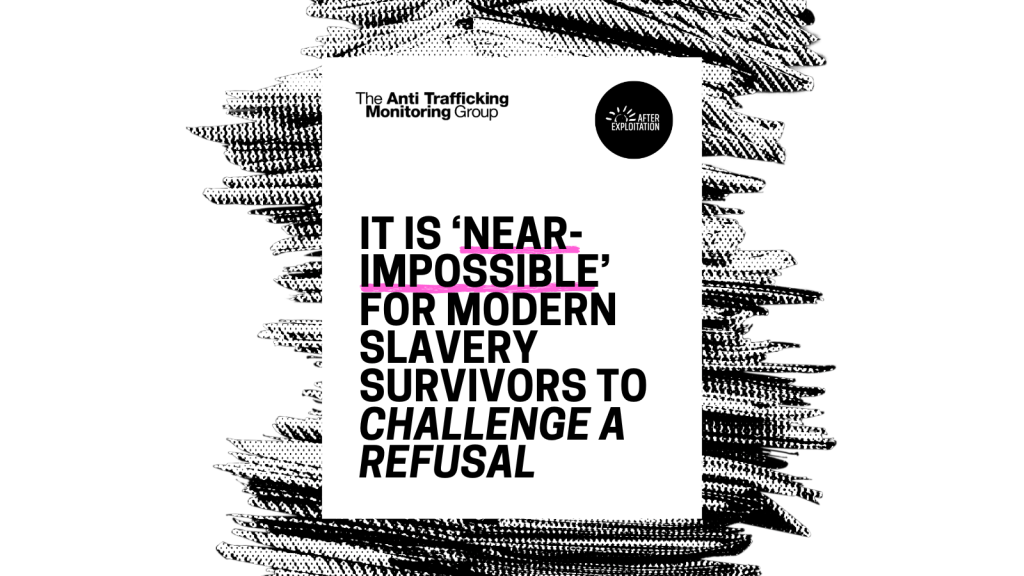
20th March 2025 – A new briefing by After Exploitation and the Anti-Trafficking Monitoring Group (ATMG) highlights the scale with which survivors of modern slavery are being turned away from support and left unable to challenge rejections.
Drawing on national data and interviews with local authorities, service providers, and legal practitioners, the research underscores the challenges facing survivors who are wrongly turned away from the National Referral Mechanism (NRM), the system for identifying and supporting victims. Analysis shows that more than half of first-stage decisions on modern slavery cases were rejected in 2023 and 2024 due to ‘insufficient proof’, compared to just 3% in 2022. First-stage ‘Reasonable Grounds’ decisions are a gateway to support for victims, and those who are refused may not have access to advice, counselling, safe housing, or protection from deportation.
A higher evidence threshold introduced via the Nationality and Borders Act 2022 makes it nearly impossible for many survivors to meet the new standard of proof.
Most rejections are later overturned when challenged
More than 70% of reconsidered cases were overturned to a positive decision last year. Yet, whilst survivors await the outcome of their reconsideration request, support is often withdrawn and survivors’ access to treatment, counselling, and safe housing is usually disrupted.
Survivors don’t have the support or time to ask for refusals to be reconsidered
In February last year, the reconsideration deadline was cut to only 30 days, despite it taking much longer than 30 days to gather relevant evidence.
“The time limit of a month is quite draconian. That is a really tight timeframe, even for someone with a lawyer. Evidence from public bodies like GPs, the NHS, the Crown Prosecution Service often take more than a month to obtain.”
– Philippa Southwell, Managing Director of Southwell & Partners
Very few survivors now request a reconsideration because of these barriers: only 8% rejected at Reasonable Grounds stage and 4% rejected at Conclusive Grounds stage.
Mental health toll causes challenges
Practitioners highlight that survivors have already overcome all odds to share their experiences and seek help and, when they are refused, many cannot bring themselves to keep fighting.
“Almost all [reconsiderations]… are overturned to a positive decision within a few weeks. This process is distressing for services users due to no fault of their own.”
– Spokesperson, Causeway
“[An NRM refusal] is very demoralising. It comes as a surprise, because that person has only just started accessing support and trusting the process. To submit a reconsideration, they have to very quickly disclose lots of traumatising information. Often the client is too unwell to share more information.”
– Silvia Nicolaou Garcia, Associate at Bindmans
Immigration status is disadvantaging some survivors
Survivors whose cases are transferred to the Immigration Enforcement Competent Authority (IECA), tasked with ‘complex’ non-UK national cases, rather than Single Competent Authority (SCA) face worse outcomes. 46% of reconsiderations were rejected by the IECA compared to 21% under the SCA.
![Opportunity: Campaign steering group [paid]](https://afterexploitation.com/wp-content/uploads/2026/02/are-you-a-campaigner-for-survivor-rights-freelance-role-1-e1770458275932.png?w=1024)




 After Exploitation