After leaving exploitation, not all survivors of modern slavery have a safe and secure place to stay. Those who are placed in safehousing still face a lottery of support.
A new installation by After Exploitation’s Maya Esslemont, Javina Greene and Kimberley Hutchison explores barriers to dignity and security in modern slavery safehousing.
There are 12 safehousing providers in England and Wales for survivors of modern slavery, funded through the government’s Modern Slavery Victim Care Contract (MSVCC) which also funds counselling and financial support for survivors. All survivors recognised as ‘potential victims’ by the Home Office should have access to safe and secure accommodation under international law[1] and the government’s own guidance states this.[2] In reality, only one in ten (13%) adult survivors enter MSVCC safehousing.[3]
Survivors can live in lots of different types of accommodation, including the homes of friends or family, asylum or temporary accommodation.[4] However, the European Convention on Action Against Trafficking (ECAT) recognises that safehousing is the most appropriate option for survivors.[5] MSVCC safehousing is held to a higher accommodation standards where the space must be “safe, fit for purpose and correctly equipped”.[6]
—————-
“The standards of other places are lower than [MSVCC] safehousing.
One of my friends, another survivors, is in asylum accommodation with water leaking through his walls every day. It’s making his mental health problems worse.“
– Modern slavery survivor and former safehouse resident
—————-
It is usually difficult for survivors to get safehousing and the decision-making criteria for who does and does not get this form of support is not transparent. The Human Trafficking Foundation finds that safehousing is usually only offered “where there is a risk of re-trafficking” and “after all other options are exhausted”,[7] yet court judgements recognise shortcomings in the way the MSVCC screens for re-trafficking risk.[8] Research by Anti-Slavery International and Hope at Home found that referrals aren’t accepted “for clients who have access to alternative accommodation”.[9] However, waiting lists for local authority accommodation are long, decision makers don’t always record whether someone is a victim of modern slavery, and being a victim of modern slavery does not automatically class someone as having a ‘priority need’ for housing.[10]
—
In the safehouse
Once living in safehousing, survivors do not always have the items they need to begin their recovery.
—————-
“They gave me old bedding, and it had been used by someone else. It hadn’t been cleaned. I didn’t mind, but they also didn’t offer me a duvet or pillow cover. The provider has improved over the years, but not at the pace that’s needed.”
“You could tell someone had been sleeping on the bed. There was a trail of dirt where someone’s feet had been. I used to sleep on top of a duvet.”
– Modern slavery survivors and former safehouse residents
—————-
MSVCC safehousing is sometimes owned by charities outright and sometimes rented out by landlords.[11] Former workers and residents interviewed for this project said the safehouses are usually residential homes renovated to fit more residents inside.
The Care Quality Commission (CQC) regulates the quality and safety of MSVCC safehousing, but does not regulate other accommodation used to house survivors. They found that MSVCC safehousing was mostly positive, but that general maintenance and safety was poor, with broken doors and fire alarms, missing toilet locks, and a lack of adaptation for disabled survivors.[12]
–
Mental health support in the housing
Within the MSVCC, mental health support is not easy to access. Survivors should have access to counselling, funded by the MSVCC, but can’t access it in practice. Last year, only 3% of adult survivors in England and Wales could access MSVCC counselling according to data obtained by After Exploitation.[13] The charity managing the MSVCC, The Salvation Army, recognises struggles to secure specialist mental health support for survivors.[14]
—————-
“When new service users [survivors] were moving into the safehouse, they would have to wait a long time for counselling. Sometimes we [support workers] would mention ‘this person is interested in counselling’ on the database, but I didn’t see a single one [survivor] who was seen by a proper psychotherapist.”
– Former safehouse support worker
—————
“I wish every safehouse had a mentor for mental health, or a psychologist who could run yoga or group therapy so you could discuss personal issues with them. Right now I’m waiting for counselling [via the NHS] and the waiting time is one and a half years.”
– Survivor of modern slavery and former safehouse resident
—————-
Survivors who cannot access counselling the the NHS have to turn to the MSVCC for mental health support, but there are significant limits on which survivors are eligible. The longest waiting times for NHS counselling are now at two years.[15] In turn, unmet mental health need is placing pressure on other services including social care and the criminal justice system.[16] Services are not equipped to deal with overlapping vulnerabilities, such as substance misuse and criminalisation arising as a result of exploitation.[17] Peer support programmes, run by survivors for survivors, are underfunded.[18]
–
The kitchen as a site of tension
Often, safehouse kitchens become sites of disagreement due to the lack of suitable equipment and floorspace to cook meals. A former support worker reports that survivors “often rubbed each other” the wrong way. “Having to share the space and share food sometimes makes the tension worse” he said. In one case, a fight broke out because one survivor would not share his peeler, and there were no other peelers for other residents to use. The former support worker said that the charity often tried its best, but that financial constraints “were hanging over us the entire time”.
Multiple survivors of modern slavery report having to save up with other survivors to buy kitchen utensils and cooking pots in order to make meals, as equipment was not provided by the charity. Whilst survivors reported that some safehouses are well equipped, others had nothing. Some had to use takeaway lids as plates, or cook entire meals using only a blunt knife due to a lack of wooden spoons.
Some survivors reported having to prepare and store food in their bedrooms in order to avoid the communal areas. This was also a way of ensuring food was not stolen by others in the safehouse.
—————-
“Staff have the right to look in your room when you’re not there, which they would do because people bought gas stoves to cook in their rooms. Even though we had our own [bed]rooms, you can smell the food through the walls.”
– Modern slavery survivor and former safehouse resident
—————-
Peoples’ belongings were often stolen and no respondents to this project had access to a locker or safe space to put their valuables. One survivor had his laptop stolen from his bedroom.
—————-
“There was a lock on my bedroom door, but do I really have to lock my door if I go to the kitchen or toilet for 30 seconds? It shouldn’t be like that.”
– Modern slavery survivor and former safehouse resident
—————-
–
Safehousing as recovery
Despite challenges, including financial constraints on MSVCC providers, survivors reported gratitude for their time in safehousing. In particular, having well-trained and knowledgeable support workers, services which provided consistent access to goods ‘without playing favourites’ amongst survivors, and those that invested in wellbeing activities within the safehouse were regarded well.
“If you have a support worker who knows what they’re doing, you feel safe. They can guide you, share links, safeguard you. They can invite you out for activities. You are rescued from a terrible situation of trauma and you have a chance to recover.”
– Modern slavery survivor and former safehouse resident
Soon, the MSVCC will expire and be replaced by the ‘Support for Victims of Modern Slavery’ (SVMS) contract. However, the tender once again makes it clear that only survivors at risk of destitution or re-trafficking are eligible for modern slavery safehousing and that “short-term therapeutic support” will only be available “where service wait times do not align to the urgency of…need”.[19] We will be monitoring whether the new service allows more survivors to access the support they need.

About the exhibit
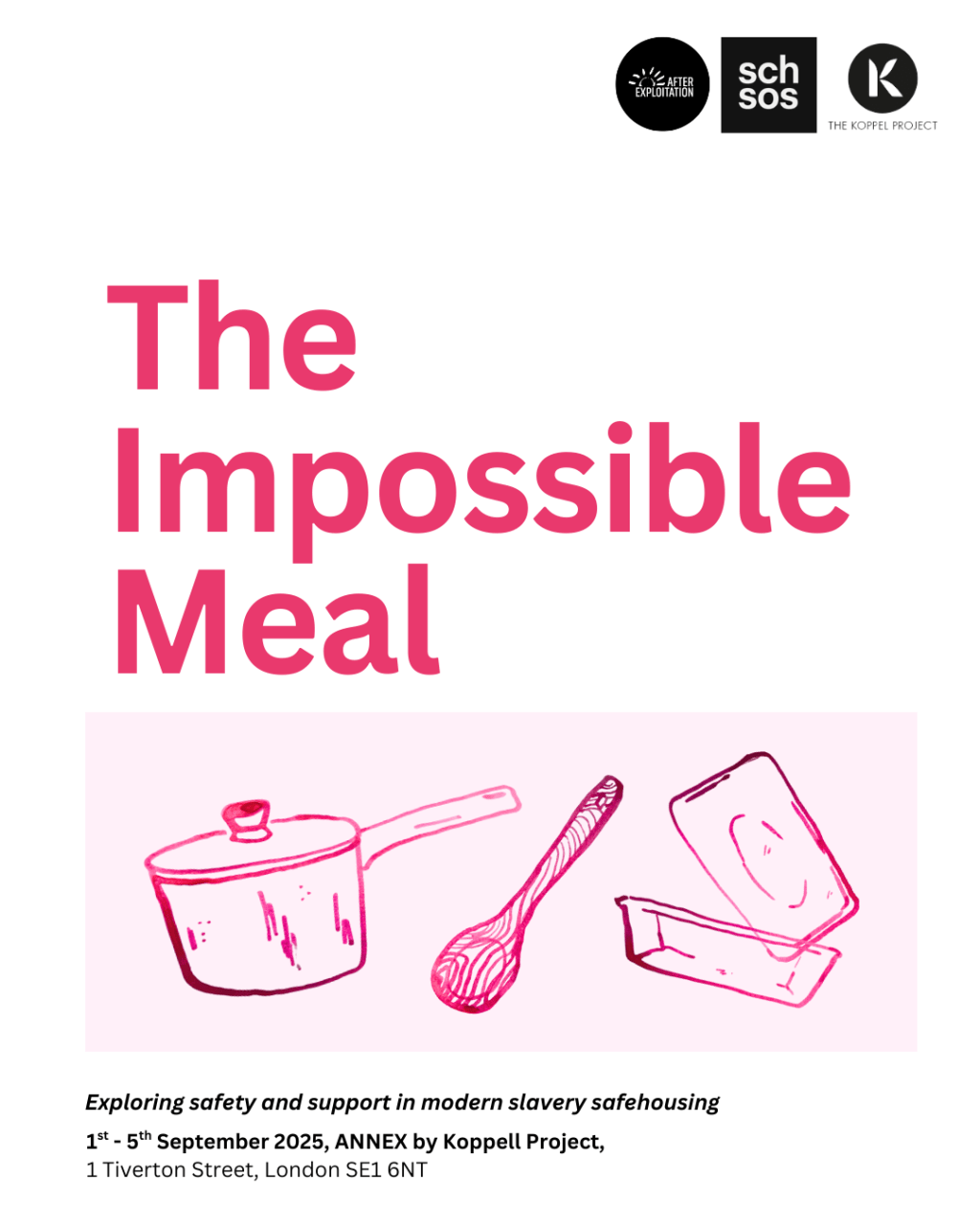
‘The impossible meal’ explores scarcity within modern slavery safehousing, through participatory artwork. Viewers are encouraged to walk to a kitchen island and follow a simple recipe for mashed potato. Viewers have limited or inappropriate tools with which to complete the recipe, may be forced to improvise, adapt, or abandon the activity altogether.
The work is produced by artist and research practitioner Maya Esslemont, researcher Kimberley Hutchison, and creative practitioner Javina Greene, a multidisciplinary team with a mix of lived and learned experience between them.
Visit the exhibition at ANNEX by Koppel Project, 1 Tiverton Street, London SE1 6NT. Open from 31st August – 6th September 2025.
[1] https://afterexploitation.com/wp-content/uploads/2025/08/67a68-thekeyissuereportoct2023.pdf pp. 13
[2] https://athub.org.uk/knowledge-base/the-victim-care-contract-msvcc/
[3] https://www.antislavery.org/wp-content/uploads/2024/08/ATMG-Safe-homes-impact-report.pdf
[4] https://www.gov.uk/guidance/homelessness-code-of-guidance-for-local-authorities/chapter-25-modern-slavery-and-trafficking
[5] https://www.cqc.org.uk/news/quality-services-provided-under-modern-slavery-victim-care-contract
[6] https://www.cqc.org.uk/publications/services-survivors-human-trafficking-and-modern-slavery/our-key-findings
[7] https://afterexploitation.com/2025/06/11/modern-slavery-mental-health-fact-sheet-only-4-potential-victims-of-slavery-and-trafficking-access-counselling
[8] https://committees.parliament.uk/writtenevidence/119861/pdf/
[9] https://www.rethink.org/news-and-stories/media-centre/2025/02/new-analysis-of-nhs-data-on-mental-health-waiting-times
[10] https://pmc.ncbi.nlm.nih.gov/articles/PMC10801359/
[11] https://committees.parliament.uk/writtenevidence/119432/pdf/
[12] https://mcpin.org/wp-content/uploads/2023/02/Resource-Project-report-Side-by-side-early-research-findings-summary.pdf
[13] https://www.find-tender.service.gov.uk/Notice/038620-2025
[14] https://www.gov.uk/government/publications/modern-slavery-victim-care-contract-assessing-destitution/modern-slavery-victim-care-contract-assessing-destitution-accessible
Home Office, Modern Slavery Statutory guidance (section 9.4.9)
[15] https://rm.coe.int/round-3-joint-shadow-submission-to-the-group-of-experts-on-action-agai/1680b0d577 (page 47)
[16] Wright, N., Such, E., Ahmed, N. & Ariyo, D. (2025) A rapid, realist-informed review of safehouse provision for survivors of modern slavery and human trafficking: A protocol. Nottingham: University of Nottingham, Rights Lab. pp. 6
[17] https://afterexploitation.com/wp-content/uploads/2025/08/67a68-thekeyissuereportoct2023.pdf pp. 10
[18] IBID
![Opportunity: Campaign steering group [paid]](https://afterexploitation.com/wp-content/uploads/2026/02/are-you-a-campaigner-for-survivor-rights-freelance-role-1-e1770458275932.png?w=1024)




 After Exploitation