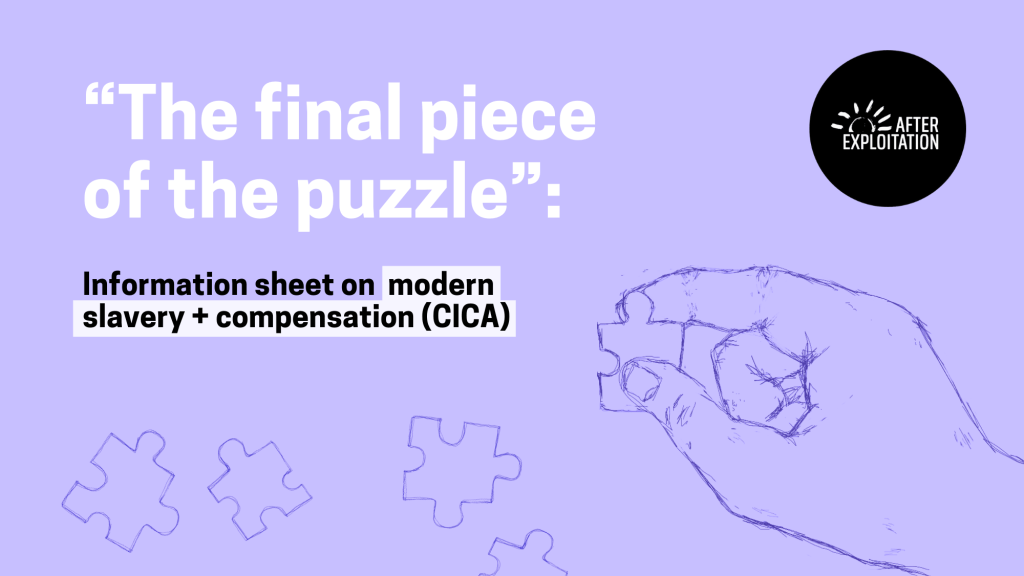
As a new briefing from After Exploitation highlights, survivors of exploitation, modern slavery and human trafficking can apply for compensation through the ‘Criminal Injuries Compensation Authority’ (CICA) but most do not. This is partly due to a lack of publicity around the scheme, as well as practical hurdles facing survivors who want to start the process.
Modern slavery consultant Emily Vaughn, who co-authored After Exploitation’s briefing on Criminal Injuries Compensation Authority (CICA) access for survivors of modern slavery, has shared some points to think about for survivors considering using the CICA scheme.
This is not intended as legal advice, but as a lived experience resource, drawing on Emily’s experiences and perspectives, which may help you consider aspects of applying for compensation which are not often discussed.
What should survivors weigh up when deciding whether to apply for CICA?
Something to consider is the emotional toll of reliving the trauma through the application process. Sadly, the process is not designed for victims of trafficking. I think it’s important to start by gathering any necessary evidence and then take the time to understand the requirements to make the application process more manageable. Keeping organised and aware of what you need to do can really help you make a decision.
Many survivors drop out of the CICA process early. What has helped you carry on pushing for a fair payout through the scheme?
I have been supported by Hope for Justice, who have been able to explain the process easily to me. They have also helped me in getting legal help. My Independent Modern Slavery Advocate (IMSA) has kept me informed along the way and supports me by taking out a lot of the stress. Getting legal advice and support when applying for CICA is really important.
What did you wish you knew about the CICA scheme before applying?
I wish I knew how invasive it could be and how emotionally and mentally demanding it is. Besides being draining, triggering, and overwhelming, it is also quite intrusive because of the evidence you need to provide. This does include records from the NHS, HMRC and police. Your lawyer may also arrange for a mental health assessment to document the mental health impact of the exploitation.
What kinds of evidence should you first start gathering?
I would start by gathering all of your GP records, hospital records, social services records, police records and basically any documents that relate to being a victim of trafficking.
What misinformation do you think exists around CICA?
A common misconception about CICA is that applicants need to have a criminal conviction against the perpetrator to be eligible, but that’s not the case.
Additionally, some people believe that CICA compensation is only available to UK citizens but, in reality, it can also be accessible to non-UK residents under certain circumstances. You may need to have a National Referral Mechanism (NRM) decision to apply if you are a non-UK national.
Another, among many common misconceptions about CICA, include thinking that it’s only available for survivors with physical injuries. In reality, it also covers psychological harm.
Some also think applicants must have reported the incident to the police immediately, but there’s actually a time-frame within which incidents can be reported.
It’s important to clarify misunderstandings or hearsay about the scheme with a lawyer to ensure you have all the accurate information you need when considering applying for CICA.
Why else is it so important to get legal advice to apply for CICA?
Getting legal advice for your CICA application is crucial because a lawyer can help you understand the eligibility criteria, navigate the application process, gather the necessary evidence, and ensure that your application is strong and well-prepared. They can also provide guidance on any legal complexities as you need to evidence how your experience can be deemed a ‘crime of violence’ under the CICA rules.
What do you think CICA can do to improve their offering to better support survivors of trafficking?
CICA should create guidance and provide specialist training to staff members on recognising and addressing the unique needs of trafficking survivors. They can also better promote their scheme through partnerships with organisations that specialise in supporting survivors of trafficking. Streamlining the application process and offering more personalised guidance to survivors can all contribute to improving outcomes.
Read the full briefing on modern slavery and compensation (CICA) here
Getting help
If you are looking for support to apply for CICA, or want to find out more information, we have included a list of organisations who may be able to help:
Reach-in support: Hope for Justice, Medaille Trust, Snowdrop Project
Legal advice: ATLEU, Rights of Women (and the From Report to Court Handbook)
![Opportunity: Campaign steering group [paid]](https://afterexploitation.com/wp-content/uploads/2026/02/are-you-a-campaigner-for-survivor-rights-freelance-role-1-e1770458275932.png?w=1024)






 After Exploitation